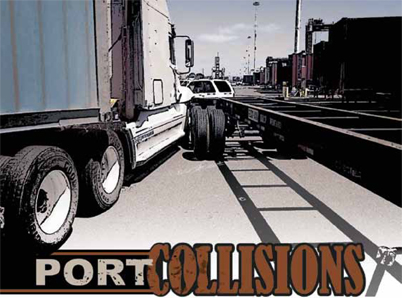
Port collisions among truckers are on the rise

portImage


Crashes at the ports are becoming an all too common occurrence as truckers line
up at terminal gates and jockey for position to get in and get out as painlessly as
possible.

At the port, traffic control is often an oxymoron. There can be trucks entering and exiting the gates from all different directions with line stalkers looking for the opportunity to cut in on truckers who leave room and/or attempt not to block onstreet traffic lanes. With inflamed tensions, trucks bottleneck at the gates. There is obvious work to be done for the ports and truckers to come together to keep tensions in check and the traffic flowing as smoothly as possible.

Be aware that in those instances when trucks are too close together and tensions
are heightened, collisions are occurring at an increased rate – it is a very frustrating
situation for all involved. On the insurance side, the ports aren’t allowing claims
professionals entrance inside the terminal gates to perform investigations. Truckers
need to understand that because of this, it becomes a “he said”, “she said”
scenario. And, if the other guy has photo evidence and/or witnesses to corroborate
his claim, the preponderance of evidence can favor the other guy. Our claims
professionals need you to be aware of this situation and be prepared to take photos
of the accident scene. Take wide (panoramic) shots as well as closeups, and if
you can, get names and numbers of any witnesses. Notable is that we have had
instances where a trucker who hit one of our guys produced witnesses that (while
they were at the port) were not at the collision site at the time of the collision. It was
only through photographic evidence that we were able to discredit those witnesses.

While the ports around the country are making efforts to smooth the flow of traffic
through appointments, extended gate hours and other efficiencies it is still the
responsibility of truck drivers to operate safely. And, if/when you have a collision
preserve the scene as best as you can through photos/video and get names and
numbers of any witnesses.

These simple actions will go a long way towards defending your liability and
protecting your safety record and loss ratio.

Seasonal driving tips

The wrong mapping device could send you over the edge

Before you go on your next trip, make sure you check the weather and road conditions, and oh yes… if you’re going to use a GPS device, choose one designed for commercial driving.

Example: A truck driver (just last month) drove almost to the top of Butterfield Canyon Utah where he came within inches of falling down a one hundred foot drop-off. Despite very narrow and winded roads, the driver kept going because his GPS instructed him to. Ultimately, he got to a place where he couldn’t make the turn. The rescue took six hours and meant two-thirds of his cargo had to be off-loaded so a front-end loader could lift the trailer around the hairpin turns to a place where the he was able to turn around.

Not all navigation systems are the same and the shortcut you trusted to save you time and fuel could end up costing you more than you bargained for. It is extremely important for truckers to understand important route restrictions, road and weather conditions. Commercial mapping devices choose routes based on your vehicle’s length, width, height, axle weight and hazardous materials onboard. They can track fuel purchases, list truck stop and service locations and include real-time weather overlays.

Adjust your driving to fit conditions

• Turn off your cruise control.
• If you lose traction with the road, gradually slow down. Don’t slam on the brakes.
• Use caution when driving on bridges or overpasses. Because of their elevation, the ground does not warm these surfaces and they are the first to freeze and become slippery when the temperature drops. Shaded areas also remain cooler and freeze faster.
• Know your route. Some roads are regularly maintained while others less frequently leaving the potential for dangerous obstacles and surface damage to contend with.
• Don’t drive fatigued. If you’re feeling tired, find a place where you can safely pull off the road and rest.
• Always perform a pre-trip inspection testing the heater and defroster, lights, wipers, battery and tires.
• Be sure to use antifreeze that’s good to -25°F; check and fill washer and other fluids and make sure hoses aren’t loose or brittle.
• Keep an automotive safety kit in your vehicle.


Underride Guards Fail Critical 30% Test

Trailer underride guards, while improved, did not pass the Insurance Institute for Highway Safety’s (IIHS) critical 30% test. According to the IIHS, trailer underride guards on modern trailers do a pretty good job at keeping vehicles from sliding underneath them, but primarily when the crash occurs directly behind the trailer. IIHS tests show that when a vehicle strikes a portion of the trailer (overlap), most trailers fail to prevent potentially deadly underrides.

In a IIHS study of 115 crashes in which a passenger vehicle struck the back of a heavy truck or semitrailer, results showed that 80% were underrides. Of those crashes involving underride, 82% were fatalities; about half of those with severe underride had overlaps of 50% or less.

IIHS engineers most recently crash-tested trailers from eight of the largest manufacturers. In each test, a 2010 Chevrolet Malibu struck a parked tractor-trailer at 35 mph. When the car was aimed at the center of the trailer, all successfully prevented the underride.  When the mid-point of the car struck the trailer edge, only one guard failed to prevent the underride.  However, when the portion of the vehicle striking the trailer was reduced to 30%, all but one failed. The 30% overlap is used by the IIHS for testing because it is the minimum overlap under which a passenger vehicle occupant’s head is likely to strike a trailer in an underride guard failure. It is important to note that in successful tests where the guards held up, the Malibu’s structure and airbags protected the dummy.
Earlier test results from the IIHS showed that the size and strength of the guards were inadequate  leading the IIHS to petition the National Highway Traffic Safety Administration (NHTSA) in 2011 for tougher standards. In that set of tests, IIHS engineers crash-tested trailers from three manufacturers (Hyundai, Vangard and Wabash). The Hyundai trailer failed all tests. Vangard failed the 50% and 30% tests while the Wabash trailer failed the 30% test.

Since 2007, under Canadian regulation, a guard must withstand about twice as much force at the point where it attaches to its vertical support compared to the U.S. rule. It’s encouraging to note that while NHTSA has not issued any additional requirements on trailer underride guards, trailer manufacturers have responded to the IIHS results by installing guards that are much stronger than required. All eight manufacturers now have underride guards meeting the Canadian standard, and none of the current designs had any difficulty passing the full-width test.

According to the IIHS, the location of the guards’ vertical supports appears to be a problem. As the supports are attached to the slider rails which allows the position of the wheels to change depending on the load, the vertical supports are located an average of 28 inches from the trailer’s edge. Manac, a Canadian manufacturer and the only one to pass the 30% test, attaches its guards to a reinforced floor and spaced just 18 inches from the edge.